go to the gnb menu go to the content

FAQ

  • 1) Go to “Product Search,” and click on the tab for the product you want.

    2) Enter the Part Number (e.g., CLL5Z105MS3NLNH) to begin the search.

    3) When the search results are displayed, check the “Status” section to see if the product is in “Mass Production” or “Under Development.” In most cases, products not included in the search results are “Discontinued Products.” However, there are some products that are not displayed for other reasons. It would be a good idea to contact our staff to see if it has been discontinued.


    Request : http://www.samsungsem.com/global/support/contact-us/inquiry.do


  • There is no specification for allowable current of MLCC.
    When DC voltage is applied into MLCC, there is no issue since almost no current flows through the MLCC, however, when the AC voltage or pulse voltage is applied, the current flows through the electrode which leads to generate heat. Therefore, check the self-heating temperature by input AC or pulse voltage when the capacitor is used.


    2-6. Self-heating Temperature ( in Datasheet)
    It is necessary to design the system, with considering self-heating generated by the ESR (Equivalent Series Resistance) of MLCC when AC voltage or pulse voltage is applied to MLCC.
    2-6-1. When MLCC is used in an AC voltage or pulse voltage circuit, self-heating is generated when AC or pulse current flows through MLCC. Short-circuit may be occurred by the degradation of MLCC’s insulating properties.
    2-6-2. The reliability of MLCC may be affected by MLCC being used in an AC voltage or pulse voltage circuit, even the AC voltage or the pulse voltage is within the range of rated voltage.
      Therefore, make sure to check the following conditions.
    1) The surface temperature of MLCC must stay within the maximum operating temperature after AC or Pulse voltage is applied.
    2) The rise in increase by self-heating of MLCC must not exceed 20℃


  • The insulation resistance is the resistance of dielectric material of MLCC. The insulation resistance value is calculated by dividing the rated voltage by the leakage current, and the leakage current is the current flows both electrodes when the rated voltage is applied. Insulation resistance is generally MΩ values, and when the voltage is applied., as shown in the picture, First, current is charged both electrode of MLCC, and therefore, insulation resistance is measured 60 seconds after the voltage is applied.


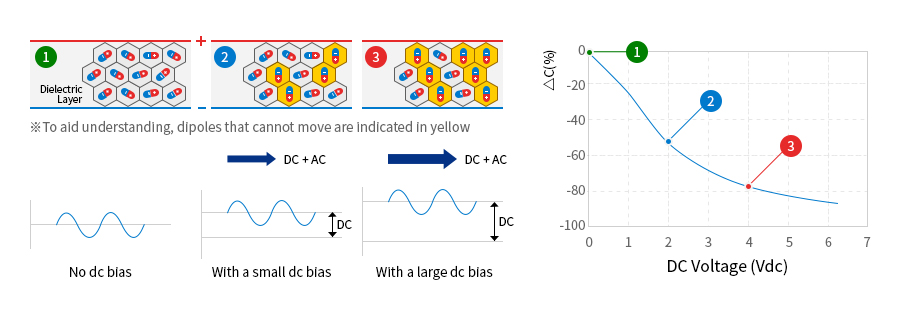
  • The capacitance value of MLCC is determined by the number of dipoles in the dielectric that are aligned at both ends of the electrode when voltage is applied as shown in the figure below. When AC voltage is applied, the capacitance value increases in proportion to the number of dipoles that move (align) according to the AC voltage. the meaning of capacitance is C=Q/V, which represents the amount of electric charge accumulated on the electrode when a voltage is applied to the MLCC. 
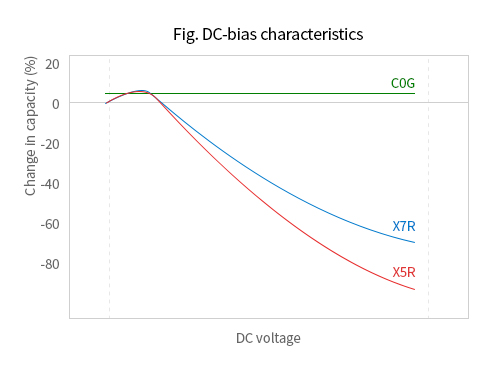


    In the case of C0G, a Class 1 type, there is no change in capacitance even when DC voltage is applied.
    However, in the case of Class 2 (X5R, X7R, etc.) type, the capacitance gradually decreases as the DC voltage increases as shown below.
    The reason is that when a DC voltage is applied, the dipoles in the dielectric are aligned and fixed according to the direction in which the voltage is applied, thereby reducing the number of dipoles that move to voltage changes (AC voltage) It is proportional to the number of dipoles reacting to AC voltage.) As the applied DC voltage increases, the number of dipoles aligned and fixed increases.
    As a result, as the number of dipoles for implementation of capacitance decreases, the capacitance value gradually decreases.
     

  • The Capacitance value of MLCC gradually decreases over time, but it does not decrease in proportion to normal time but decreases in proportion to logarithm time as shown in the diagram.


    This is a part of the process in which mechanical stress is diminished within the MLCC molecular structure, forming a 90˚ dipole. In accordance, the degree of freedom of the dipole of dielectric within the MLCC gradually decreases, and even if the AC voltage for capacitance measurement is applied. the dipole gradually fails to move, resulting in a decrease in of capacitance value.


  • Unlike the concept of rated voltage of general electronic products, MLCC rated voltage is a concept that is related to reliability. Product which is passed reliability test under certain rated voltage is considered as its rated voltage available one. If input voltage exceed rated voltage, it would be no issue until a certain extent but failure may occur when it applied for a long period of time. And it lead to shorten the MLCC lifespan.

    In each voltage type below, the Vp-p max should be used so that it does not exceed the rated voltage. And for longer use, the rated voltage of MLCC should be increased according to the applied circuit.


  • The MLCC product is grouped based on temperature characteristics, and the temperate ranges for X5R is -55~85˚C and X7R is -55~125˚C. This does not mean that the MLCC can operate in the relevant temperature but indicates that the change to capacitance value in the temperature range is within ±15% or ±22%. As a result, should you continue to use the MLCC at the maximum temperature of the temperature range, the lifespan of the product may drastically decreased.
  • Generally, the ESR value for MLCC changes based on the capacitance value. In the case of high capacitance value of 1μF or more, it shows few Ω to dozens of Ω, and as shown in the below diagram, the ESR value of MLCC is generally lower than the AL Cap. Or Tantal Cap.


  • In the case of high dielectric MLCC types, as time passes, capacitance value decreases, and therefore, when measuring capacitance after long period of storage time, the range of capacitance value may exceed the spec range. When measuring after a long period of storage time, you must measure capacitance after pretreatment (150˚C, 1 hour).
  • MLCC types can be classified Class1 (thermometer) and Class2 (high dielectric system).
    Class 1 type uses titanium oxide as a dielectric material, and capacitance value changes according to temperature or voltage in ppm units. The attainable capacity standard is nF units or less, and is generally used for impedance matching.
    Class2 uses a dielectric called Barium Titanate, attains μF-level capacity, and is generally used for decoupling, and the capacity change with regards to temperature change or voltage approval is relatively large.


For more information, please submit a customer inquiry, and our C/S representative will get back to you.

Inquiry
Online PR Hall Subscribe to Newsletter Latest Articles